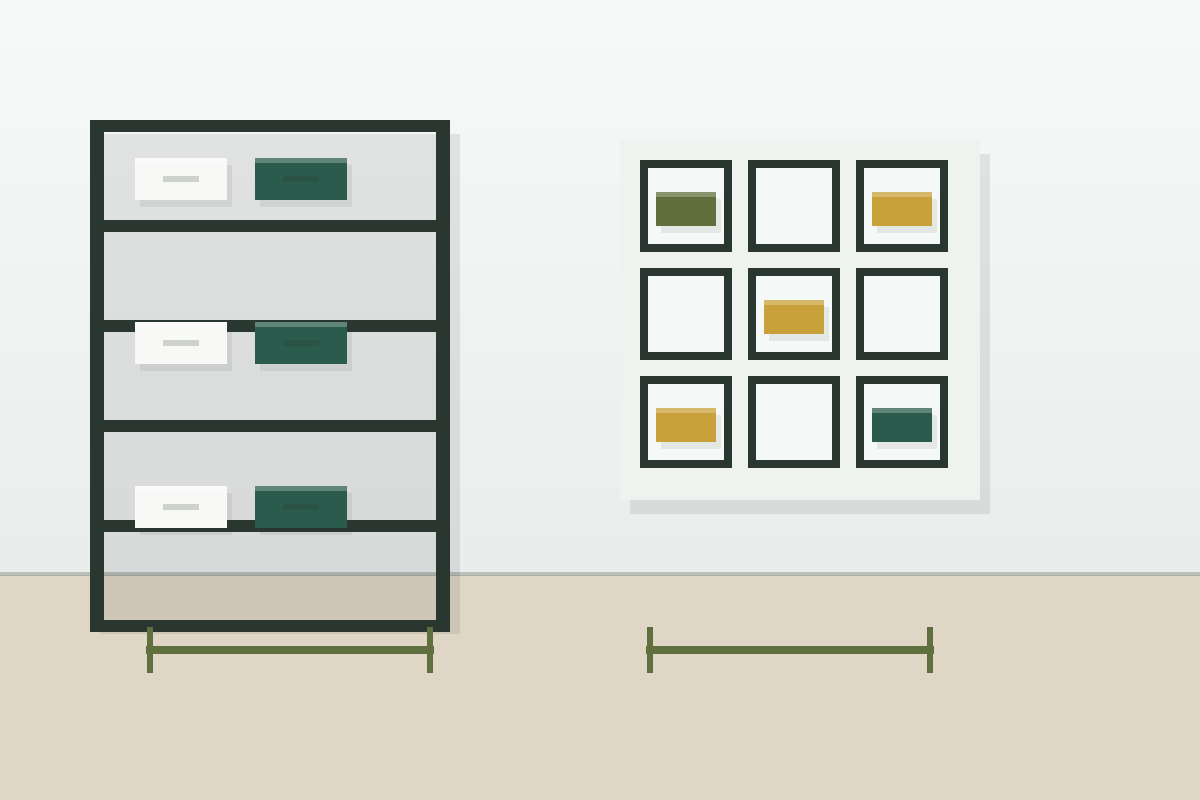
The short answer
What usually works in a small apartment
Choose wire shelving when adjustability, airflow, utility-room cleaning, and high published load ratings matter. Choose cube shelving when the unit is visible, 13-inch bins are part of the plan, and each compartment will hold moderate household items. Neither format is automatically safer: tall units still need the manufacturer-specified restraint, loads belong low, and the floor must be level. The decisive measurements are depth in the walking path, usable shelf or cube opening, and the rating for the exact configuration you will use.
- Wire wins for adjustable utility storage; cubes win for calmer visible storage.
- Use the exact manufacturer's per-shelf rating, not a rating from a similar model.
- Anchor the unit when the instructions require it, especially in homes with children.
6 real products compared by fit
These are dimensional reference points, not a universal ranking. Prices are snapshots checked August 21, 2026. Open the current source page before buying to verify the exact finish, model, availability, included hardware, return terms, and current instructions.
| Product | Price checked | Outside dimensions | Capacity | Published load | Best fit |
|---|---|---|---|---|---|
| Seville Classics 5-tier steel wire shelving | $79.99 | 30 W x 14 D x 60 H in on feet; 61.5 H on casters | 5 adjustable shelves | 300 lb per shelf / 1,500 lb total on feet; 110 lb total on wheels | Dense pantry, laundry, or utility storage with adjustable heights |
| IKEA OMAR narrow shelf unit | $50.00 | 18 1/8 W x 14 D x 37 H in | 3 wire shelves | 35 lb per shelf | A narrow utility bay where adjustable wire shelves beat bins |
| IKEA OMAR wide shelf unit | $65.00 | 36 1/4 W x 14 D x 37 H in | 3 wire shelves | 73 lb per shelf | Low, wide pantry or laundry storage with more shelf-span capacity |
| IKEA KALLAX 4-cube shelf unit | $49.99 | 30 1/8 W x 15 3/8 D x 30 1/8 H in | 4 cube compartments; compatible with 13 x 13 in inserts | 29 lb per shelf; 55 lb top | Visible living-room or studio storage using repeatable cube bins |
| Target Brightroom 13-inch 6-cube organizer | $65.00 regular price | 43.8 W x 14.6 D x 30 H in | 6 cubes compatible with the 13-inch system | 30 lb per shelf; 180 lb total | A low media wall or room divider that needs six visible categories |
| Better Homes & Gardens 4-cube organizer | $44.44 when checked | 30.16 W x 15.35 D x 29.84 H in | 4 cubes; about 13 W x 15 D x 13 H in each | 30 lb per cube; 100 lb top | Four large compartments where exact interior dimensions help bin selection |
Product-by-product apartment fit notes
Outside dimensions are only the first screen. The notes below translate the published specifications into door, walkway, access, cleaning, and installation checks. A missing rating is left as not published rather than being estimated from a similar product.
Pick 1 · $79.99 checked August 21, 2026
Seville Classics 5-tier steel wire shelving
This is the load-rated utility choice. Shelves adjust in one-inch increments, liners can support small items, and the stationary configuration carries far more than the wheeled configuration. That rating difference is central: adding casters changes the system from 1,500 pounds total to 110 pounds total. A 14-inch depth also needs a generous walkway, so tape it before treating the vertical capacity as free space.
Check before buying: Use only the rating for the assembled configuration and keep heavy loads low and evenly distributed.
Pick 2 · $50.00 checked August 21, 2026
IKEA OMAR narrow shelf unit
The narrow OMAR uses less wall width than most cube units while retaining a 14-inch shelf depth. Its published 35-pound shelf rating suits routine household supplies rather than workshop-scale loading. Because the wire surface can imprint soft packages or let small objects tip, add a correctly sized liner or contained bin rather than balancing loose items across the gaps.
Check before buying: IKEA instructs users to anchor the unit; include the restraint and wall type in the rental plan.
Pick 3 · $65.00 checked August 21, 2026
IKEA OMAR wide shelf unit
The wide OMAR doubles the narrow model's wall width and raises the published per-shelf rating to 73 pounds. It works when long items or several bins need one continuous shelf. The 37-inch height keeps the top reachable, but a wide wire span still needs level assembly and balanced loads. Measure around baseboards so all feet land fully on the same surface.
Check before buying: The unit must be secured as instructed; do not treat low height as automatic tip resistance.
Pick 4 · $49.99 checked August 21, 2026
IKEA KALLAX 4-cube shelf unit
KALLAX is deeper than the wire options here and turns the contents into four framed visual zones. It suits records, folded textiles, toys, and moderate household categories when each cube has a purpose. IKEA lists a 29-pound shelf limit and 55-pound top limit, but does not publish the exact clear opening on the product page; test any non-IKEA insert rather than assuming the nominal 13-inch accessory size is the opening.
Check before buying: IKEA requires wall fastening; keep dense contents low and respect the rating for each shelf.
Pick 5 · $65.00 regular price checked August 21, 2026
Target Brightroom 13-inch 6-cube organizer
The six-cube Brightroom unit spreads storage across 43.8 inches, so it behaves more like a low console than a narrow bookcase. Its 14.6-inch depth and 180-pound total rating are useful comparison points, but the wall width and furniture layout decide whether it is apartment-friendly. Plan cables, floor vents, and baseboards before placing it behind a sofa or near an entry.
Check before buying: Price and color availability vary; verify the exact SKU, included hardware, and assembly orientation on the current listing.
Pick 6 · $44.44 when checked checked August 21, 2026
Better Homes & Gardens 4-cube organizer
This organizer publishes interior compartment dimensions, which makes it easier to compare inserts before ordering. The 15.35-inch overall depth is substantial in a small room, while the 13-inch-high openings accept common cube-bin proportions. Use the 30-pound compartment rating independently; a strong top panel does not raise the limit inside each cube.
Check before buying: The checked listing showed changing stock; verify current SKU, finish, price, restraint instructions, and return terms.
Decide by room job, not furniture style
Wire shelving is a utility system: open airflow, adjustable heights, washable surfaces, and often explicit load ratings. Cube shelving is a visual system: repeated compartments, optional bins, and a furniture-like face that can divide categories in a living room. The same apartment can use both, but they should not compete for the same job.
Start with the contents. Heavy pantry cases, appliances, or dense supplies favor a correctly rated wire unit. Toys, folded textiles, media, and visually mixed small items often benefit from cubes and bins. Books are deceptively dense; use the exact compartment rating and avoid filling a decorative organizer simply because the books physically fit.
- Utility and adjustability point to wire
- Visible categories and bins point to cubes
- Dense loads require an exact published rating
Compare depth before width
In this shortlist, wire units are about 14 inches deep while cube units are roughly 14.6 to 15.38 inches deep. That extra inch can matter beside a bed, behind a sofa, or in an entry. Tape the full depth and add bin handles, cords, and any contents that project beyond the front plane.
Width changes how the room is zoned. An 18 1/8-inch OMAR can occupy a narrow utility bay; a 43.8-inch six-cube organizer acts as a console or divider. Check outlets, floor registers, baseboards, and the route used to carry assembled parts. A unit that fits the wall may not fit the stair turn or elevator.
- Outside depth plus projecting contents
- Wall width after outlets and trim
- Move-in route and assembled orientation
Read load ratings as configuration-specific
Ratings belong to an exact model, shelf, and assembly. Seville's five-tier unit is rated for 300 pounds per shelf on leveling feet but only 110 pounds total when configured on wheels. KALLAX lists 29 pounds per shelf and a separate 55-pound top limit. Neither number transfers to a lookalike product.
Use conservative, evenly distributed loads and place the densest categories low. A bin can hide how much weight has accumulated, so weigh a representative loaded bin before multiplying it across compartments. Recheck clips, posts, fasteners, and level after the first week and after any move.
- Stationary versus caster configuration
- Per-shelf, per-cube, and top limits
- Even distribution and low center of gravity
Use liners and bins for a reason
Wire liners stop small jars, packets, and soft packages from tipping or sagging. Choose a liner sized for the shelf and check that its surface remains cleanable in a pantry or laundry zone. A liner does not raise the load rating and should not hide an incorrectly seated shelf clip.
Cube bins calm visual clutter and create removable categories, but they reduce usable opening size. Measure the exact interior and the bin's outside dimensions, including handles and folded seams. Leave enough height to grip and withdraw the bin; a nearly friction-fit cube feels tidy in a photo and frustrating in daily use.
- Liner for small or soft items
- Bin for a repeatable visible category
- Grip clearance for every pull-out container
Anchor, level, and load the finished unit
Follow the restraint instructions supplied with the exact product. IKEA explicitly calls for wall fastening on the OMAR and KALLAX examples in this guide. The CPSC's Anchor It! material explains the broader tip-over hazard, but it does not replace a manufacturer's hardware, wall-type, or assembly instructions.
Leveling matters on apartment floors that slope or change at rug edges. Make sure all feet contact the same stable surface and do not bridge a thick rug with only part of the base. Load from the bottom up, test for rocking without climbing or pulling, and keep children from using shelves or cubes as steps.
- Correct restraint for wall material
- All feet on one level surface
- Heavy categories on the lowest usable level
Three apartment layout scenarios
For pantry overflow, a rated wire shelf with liners usually wins because shelf height can follow appliances, cans, and bins. In a studio living zone, a low cube unit can separate categories and act as a visual boundary, provided its depth does not tighten the main route. Inside a closet, the choice depends on hanging-clothes clearance and whether bins need to slide out.
Do not force one system through the entire apartment. A narrow OMAR beside a laundry machine and a four-cube unit under a living-room wall can each be correct. The shared rule is to measure the loaded footprint, use only the exact rating, and preserve access for cleaning, outlets, doors, and daily movement.
- Pantry: adjustable wire plus liners
- Living room: lower cube storage with deliberate bins
- Closet: whichever preserves hanging and pull-out clearance
Final fit check before checkout
Use this as a last pass after you have narrowed the list to one or two exact models. Product photos are not scaled to your room, and a nominal capacity does not prove access after the item is loaded.
| Check | Measure | Verify |
|---|---|---|
| Room footprint | Outside depth and width | Add bins and projected contents |
| Opening | Shelf span or clear cube interior | Do not infer an interior size |
| Load | Exact assembled configuration | Separate shelf, top, and caster ratings |
| Stability | Level floor and restraint | Follow maker anchoring instructions |
| Move | Door, stair, and elevator route | Check assembled orientation |
Related small-space guides
Continue with guides that solve the next storage decision in the same apartment zone.

FAQ
Is wire shelving or cube storage better for a small apartment?
Choose wire shelving for adjustable utility storage and cube storage for visible, repeatable compartments. The better option is the one that fits your real contents, walkway, floor, and manufacturer-recommended stability setup.
What is the difference between wire and solid shelving?
Wire shelves improve airflow and make spills less likely to pool, but small items often need liners. Solid shelves support packets, books, and decor directly, but their finish, sag resistance, and wipeability matter more.
Are cube storage shelves strong enough for books?
Some are, but dense books can exceed the rating or make a tall unit top-heavy. Check the per-cube or per-shelf rating, keep books low, and follow the supplied anti-tip instructions.
How do I measure bins for cube storage?
Measure the clear inside width, height, and depth of one cube. Leave room for handles and fingers; a bin that exactly matches the opening can scrape or become difficult to pull.
Do wire shelves need liners?
Use liners for pantry packets, small bottles, folded clothing, and anything that could tip, snag, or sit unevenly on the wire grid.
Which shelf type is easier to move between rentals?
Wire units often break down into lighter components. Cube units can move well when small, but large particleboard units may loosen or chip, so check assembly and disassembly instructions before buying.