The short answer
What usually works in a small apartment
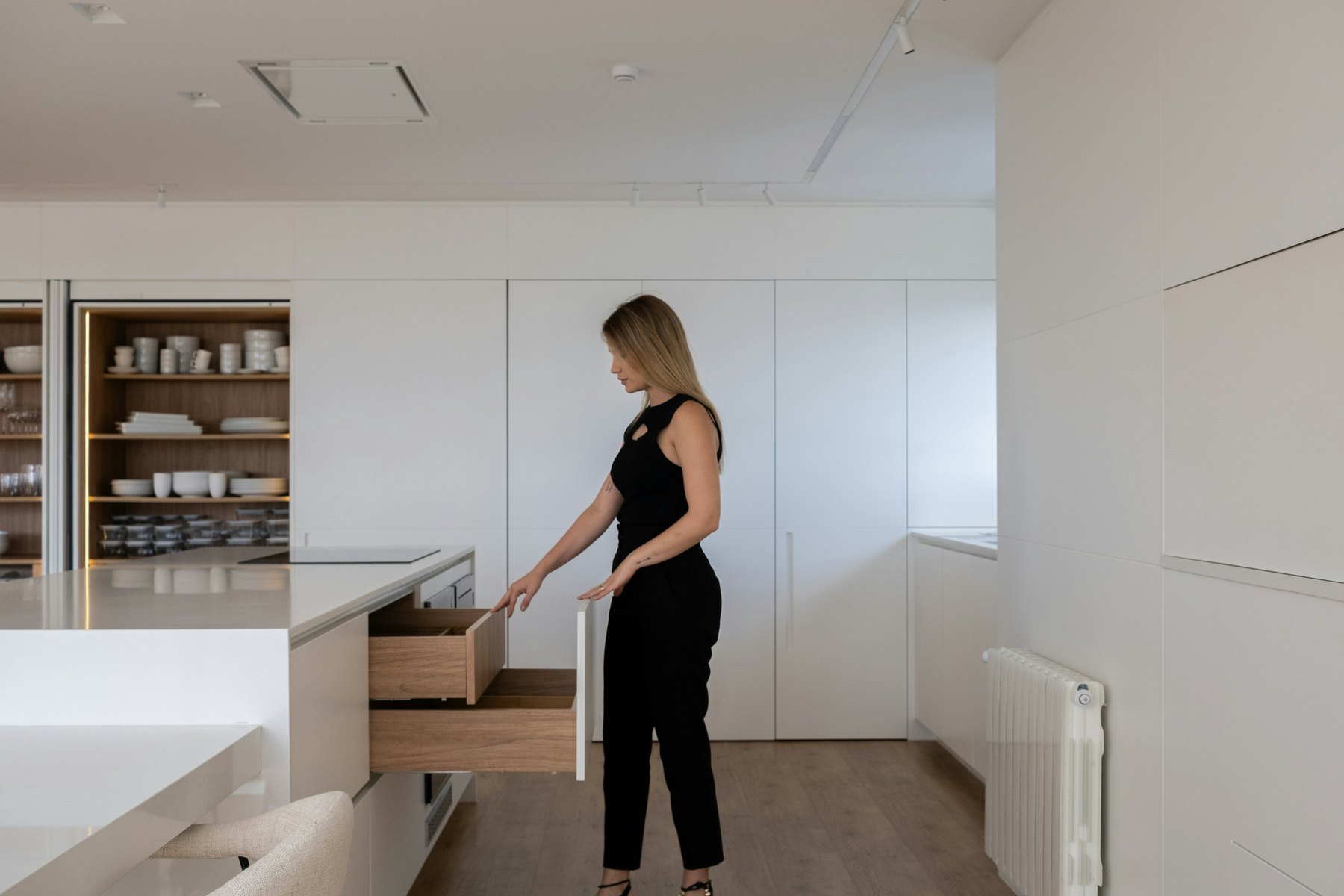
The useful cabinet dimension is the narrowest clear opening after hinges, face frames, shelf lips, plumbing, and the door angle are counted. A freestanding riser is the lowest-risk first move; a turntable solves reach at the back; a vertical rack separates pans or lids; and a pull-out earns its hardware only when the rail path and door clearance are proven. The products below range from a five-inch-deep shelf insert to a mounted under-sink pull-out, making it easier to buy for the cabinet you have instead of the staged cabinet in a product photo.
- Record clear opening width, usable depth, shelf spacing, and hinge intrusion.
- Start with a removable riser or rack before drilling for a pull-out.
- Check loaded access: a technically fitting organizer can still block your hand or door.
7 real products compared by fit
These are dimensional reference points, not a universal ranking. Prices are snapshots checked August 21, 2026. Open the current source page before buying to verify the exact finish, model, availability, included hardware, return terms, and current instructions.
| Product | Price checked | Outside dimensions | Capacity | Published load | Best fit |
|---|---|---|---|---|---|
| IKEA VARIERA shallow shelf insert | $16.99 | 12 5/8 W x 5 1/8 D x 6 1/4 H in | One shallow raised tier | Not published | Mugs, bowls, or spice jars in a shallow upper cabinet |
| IKEA VARIERA deep shelf insert | $19.99 | 12 5/8 W x 11 D x 6 1/4 H in | One full-depth raised tier | Not published | Plates, bowls, glasses, and short pantry rows in a deeper cabinet |
| IKEA VARIERA pot lid organizer | $7.99 | 5 3/4 W x 4 H; adjusts 3 1/4 to 19 3/4 L in | Adjustable dividers; fixed item count not published | Not published | Lids, boards, or flat bakeware that currently form an unstable stack |
| IKEA VARIERA lazy Susan | $9.99 | 10 1/4 diameter x 1 1/2 H in | One rotating tray | Not published | Bottles and jars at the back of a shelf that are hard to reach |
| YouCopia ShelfSteps can organizer | $19.99 | 13.4 W x 6.5 H; expands 4.8 to 12.6 D in | 16 to 24 cans | 30 lb total | A pantry shelf where identical cans hide behind one another |
| YouCopia StoreMore expandable pan and lid rack | $34.99 | 7.3 D x 12.6 to 21.5 W x 6.3 H in | 10 adjustable dividers | Check current product page | Wide lower cabinets where pans and lids need vertical separation |
| IKEA UTRUSTA under-sink organizer | $34.99 | 13 3/4 W x 11 1/2 D x 17 H in | Two adjustable pull-out trays | 22 lb total; maker states 8 kg and 2 kg by tray | A measured 24-inch-deep base cabinet with a clear side-mounting zone |
Product-by-product apartment fit notes
Outside dimensions are only the first screen. The notes below translate the published specifications into door, walkway, access, cleaning, and installation checks. A missing rating is left as not published rather than being estimated from a similar product.
Pick 1 · $16.99 checked August 21, 2026
IKEA VARIERA shallow shelf insert
The shallow VARIERA adds a second level without consuming the full cabinet depth. It works when short items can live below and frequently used items remain visible above. Because its height is 6 1/4 inches, measure the lower stack plus finger clearance and the items that will sit on top. The compact depth leaves space in front or behind, which is useful only if those zones remain accessible.
Check before buying: The product page does not publish a load rating; keep dense cookware off an unrated riser.
Pick 2 · $19.99 checked August 21, 2026
IKEA VARIERA deep shelf insert
The 11-inch version uses more of a wall cabinet's depth and can separate two short categories that were previously stacked. It can connect to additional inserts, but a larger arrangement still has to pass through the clear door opening. Treat 12 5/8 inches as the outside width, then verify hand access on both levels; doubling vertical surfaces is not useful if the back row disappears.
Check before buying: Check plate diameter and door closure, and do not assume a load rating from customer photos.
Pick 3 · $7.99 checked August 21, 2026
IKEA VARIERA pot lid organizer
VARIERA turns flat items on edge and adjusts in length, so it can be sized to the category instead of filling the cabinet. The key dimension is the height of the largest lid or board after it is tilted through the opening. Use it where dividers stop items from leaning into hinges, pipes, or the neighboring stack, and leave a grip zone at the front.
Check before buying: The maker does not publish a fixed capacity or load; count your actual pieces and test their combined weight.
Pick 4 · $9.99 checked August 21, 2026
IKEA VARIERA lazy Susan
A 10 1/4-inch turntable exchanges corner capacity for access: every item can rotate to the front, but the circle leaves unusable space around it. It is strongest for upright bottles whose diameter and height are consistent. Place the tallest bottle on the tray, add the 1 1/2-inch platform height, and verify that the cabinet shelf above and the door both clear the loaded rotation.
Check before buying: Round trays are poor fits for rectangular boxes; test the loaded circle, not just the empty base.
Pick 5 · $19.99 checked August 21, 2026
YouCopia ShelfSteps can organizer
ShelfSteps creates three visible levels and adjusts its depth to the shelf. The maker lists a 2.25-inch tier rise, a 30-pound total limit, and a 16-to-24-can range. That combination is more useful than a generic 'holds cans' claim. Measure the tallest can on the rear tier because the organizer's 6.5-inch body height is only part of the loaded height.
Check before buying: Confirm that the expanded depth still leaves enough front clearance to lift a can without striking the shelf above.
Pick 6 · $34.99 checked August 21, 2026
YouCopia StoreMore expandable pan and lid rack
StoreMore expands sideways and supplies ten dividers, so a household can size slots for specific pans, lids, or boards. The 7.3-inch rack depth is compact, but handles and lid diameters determine the true envelope. Expand it only as wide as the clear opening allows, then pull the largest pan straight out to confirm it does not catch the hinge or adjacent handle.
Check before buying: Use the linked maker information as a research start and recheck the current listing before purchase because configurations can change.
Pick 7 · $34.99 checked August 21, 2026
IKEA UTRUSTA under-sink organizer
UTRUSTA is the most installation-dependent option here. It attaches to a cabinet side and pulls out, so clear width alone is insufficient: map plumbing, disposal, hinges, the side panel, screws, and the entire 11 1/2-inch travel path. The maker lists a 22-pound total and separate tray limits, which helps assign dense bottles low and lighter supplies above.
Check before buying: It is designed for specified IKEA base cabinets; non-IKEA installation may require judgment or hardware beyond the product page.
Map the usable cabinet box
Measure the narrowest clear opening with the door in its normal open position. Face frames, hinges, door edges, and center stiles can make this number far smaller than the cabinet's nominal width. Record usable depth from the obstruction at the front to the back wall, not from the outside of the door.
For vertical fit, measure each shelf gap independently and include the item that will sit on the organizer. A 6 1/4-inch riser plus a six-inch bowl stack needs more than 12 1/4 inches because fingers still need room to lift the lower and upper items. Under sinks, draw plumbing and disposal zones instead of pretending the cabinet is an empty rectangle.
- Narrowest clear door opening
- Usable depth after hinge and pipe intrusion
- Organizer plus item height plus hand clearance
Match the organizer to the access problem
A riser fixes vertical stacking, a turntable fixes back-row reach, a vertical rack fixes leaning pans or lids, and a pull-out fixes deep access. These products are not interchangeable. Identify the repeated motion that causes frustration: unstacking bowls, losing cans, lifting pans, or kneeling to reach a back corner.
Solve one cabinet first. A successful insert can be repeated after a week of use; a poor system bought in multiples becomes expensive clutter. Removable options are especially useful in rentals because they reveal whether the category and shelf spacing are correct before screws, rails, or cabinet-specific fittings enter the plan.
- Riser for unused height
- Turntable for unreachable back rows
- Vertical divider for unstable flat items
- Pull-out only for a proven travel path
Riser and turntable clearance math
For a riser, add the organizer height to the tallest item below or above, whichever creates the larger stack. Then add finger clearance. Confirm the width at the door opening, because a 12 5/8-inch insert may fit inside a cabinet but not pass a hinge or center stile at the angle required for installation.
For a turntable, trace the full loaded circle. Bottle shoulders can extend beyond the tray edge and strike the side wall or door. Add the tray height to the tallest bottle and rotate the heaviest realistic set by hand. A circle can improve access while reducing raw capacity, which is a good trade only when every stored item becomes easier to see and retrieve.
- Loaded height, not empty organizer height
- Full rotation with the widest bottle
- Clear grip space above both levels
Pull-outs need a rail path, not just width
A pull-out must clear the door edge and hinge for its entire travel. Side-mounted models also need a structurally suitable panel and hardware position. Put painter's tape on the cabinet floor to represent the organizer, then move a box through the intended path while the door is held at its everyday angle.
Check weight before installation. Cleaning bottles and cookware become dense quickly, and a total load may be divided unevenly by tray. Follow the maker's mounting template and limits. If the cabinet is old, damaged, unusually thin, or part of a rental where drilling is restricted, a removable bin or turntable is the more prudent first choice.
- Door and hinge clearance through full travel
- Side-panel condition and permitted fasteners
- Per-tray and total load limits
Use standard cabinet sizes only as orientation
Planning guides commonly describe standard base cabinets as 24 inches deep and 34 1/2 inches high, with many wall cabinets around 12 inches deep. Those figures help explain why organizer families cluster around certain sizes, but they do not prove fit in an installed kitchen. Face frames, doors, backs, shelves, and plumbing consume the usable space.
The IKEA UTRUSTA under-sink organizer, for example, is described for specified 24-inch-deep cabinet systems but its own body is 13 3/4 by 11 1/2 by 17 inches. Compatibility still depends on the correct side and unobstructed mounting zone. Treat every 'fits standard cabinets' statement as a prompt to verify the actual cabinet.
- Nominal cabinet size
- Actual interior box
- Clear opening and hardware path
Run a one-week access test
Install or place one organizer and use the cabinet normally for a week. Notice whether the front row blocks the back, whether items migrate off the organizer, and whether cleaning becomes easier. Good organization reduces motions; if a riser creates two cramped stacks or a turntable requires removing one bottle to rotate, it has not solved the access problem.
Before repeating the system, remeasure after loading because shelves can flex and items can project past the footprint. Keep the receipt and packaging through the retailer's return window. Record the exact model and dimensions that worked so a later purchase matches, rather than relying on a product family name that may contain several sizes.
- Count daily retrieval steps before and after
- Check door closure with the cabinet fully loaded
- Repeat only the exact proven size
Final fit check before checkout
Use this as a last pass after you have narrowed the list to one or two exact models. Product photos are not scaled to your room, and a nominal capacity does not prove access after the item is loaded.
| Check | Measure | Verify |
|---|---|---|
| Opening | Narrowest clear width | Measure between hinge, frame, and door edge |
| Depth | Front obstruction to back wall | Include pull-out travel or tray rotation |
| Height | Organizer plus tallest item | Add hand and lift clearance |
| Load | Real contents | Use per-tier and total limits |
| Installation | Panel, rail, and screw zone | Confirm rental permission before drilling |
Related small-space guides
Continue with guides that solve the next storage decision in the same apartment zone.
FAQ
What cabinet organizer should I buy first for a small kitchen?
A shelf riser is usually the lowest-risk first buy because it adds usable height without hardware or precise drawer clearance.
Are pull-out cabinet organizers renter-friendly?
Freestanding pull-outs can be renter-friendly if they do not require screws and fit around hinges, cabinet lips, and plumbing.
How do I organize pot lids?
Use a vertical lid rack or file-style organizer near the matching pots. Check lid handle height before choosing a tight slot system.
How do I measure for cabinet organizers?
Measure interior width, depth, and height, then record the narrowest clear opening between hinges or the front frame. Also check the front lip, door angle, and full pull-out path.
Can too many cabinet organizers waste space?
Yes. Add the smallest organizer that fixes the access issue, then stop before gadgets take over usable cabinet volume.