The short answer
What usually works
Add usable bathroom storage without holes, sticky residue, wobbly towers, or counters crowded with backups.
- No-drill storage works best when it is light, removable, washable, and assigned to daily-use items.
- Over-door racks, caddies, trays, and slim carts are safer defaults than heavy adhesive shelves.
- Bathrooms need drainage and cleaning access, not just more visible storage.
Who this guide helps
- Renters
- Small bathrooms
- Pedestal sinks
- Shared bathrooms
Product-type comparison
| Option | Best for | Check before buying |
|---|---|---|
| Over-door rack | Towels, robes, toiletries | Check door clearance |
| Tension corner shelf | Shower products | Needs solid contact points |
| Slim rolling cart | Toiletries and backups | Requires floor parking space |
| Countertop tray | Daily routine items | Can become clutter if oversized |
How to choose
- Moisture: Bathroom storage should be washable and resistant to rust or swelling.
- Removal: Avoid products that require scraping, heat, or patching if the lease is strict.
- Stability: Tall units need a safe way to prevent tipping.
- Daily routine: Prime space should hold what you use every morning or night.
Measure before buying
No-drill bathroom storage should be light, removable, washable, and honest about moisture. The goal is clear daily access, not filling every wall and door.
- Door clearance: Measure whether over-door racks clear the frame and still let the door close without rubbing.
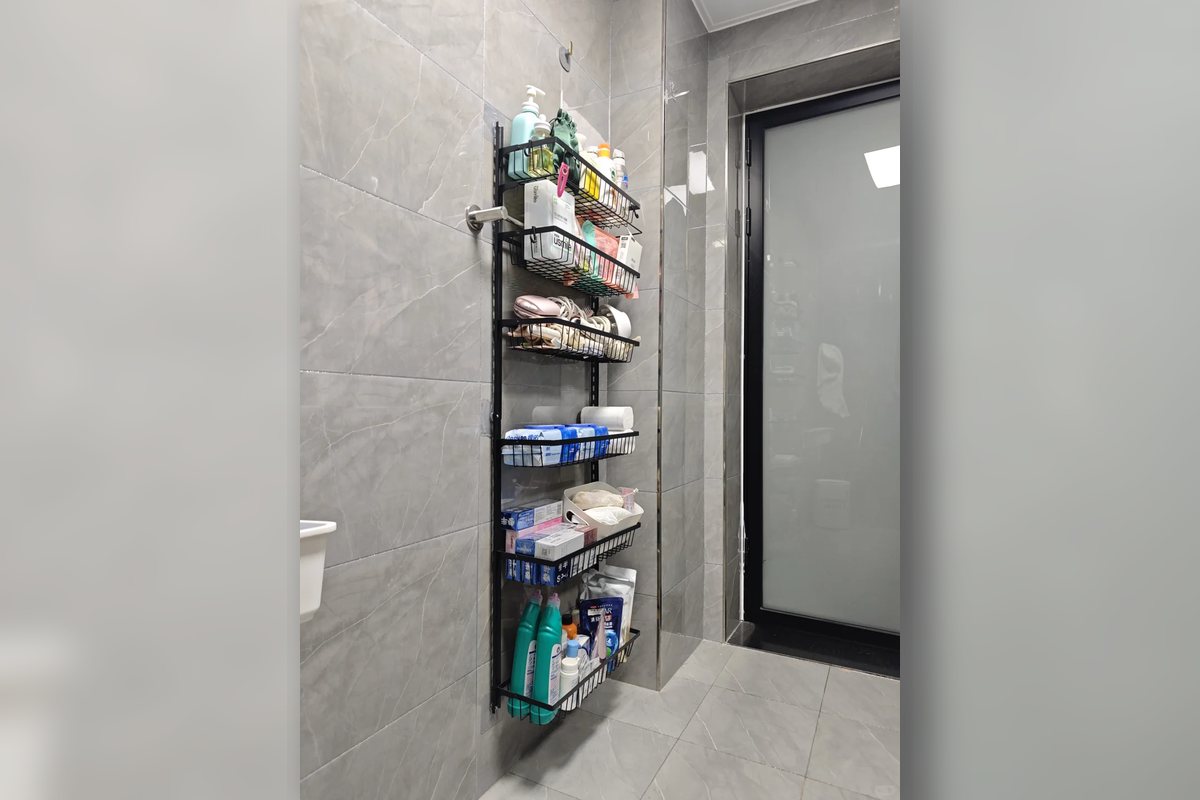
- Shower surface: Check tile texture, grout, showerhead shape, and corner height before choosing suction, hanging, or tension storage.
- Counter footprint: Limit trays to the daily items that actually deserve visible counter space.
- Floor parking: Measure whether a slim cart can park without blocking the toilet, sink, shower, or door swing.
Apartment size scenarios
Use these examples to translate the guide into a real apartment layout before you compare products.
Pedestal sink bathroom
Use a slim cart, over-door rack, or portable caddy instead of trying to force storage around the pedestal base.
Shared bathroom
Give each person a portable caddy or labeled bin so the counter does not become shared overflow.
Tiny shower stall
Choose a hanging or corner caddy only if it does not steal elbow room or block the shower curtain.
Choose it if / skip it if
Choose it if
- You rent and need removable storage for daily bathroom routines.
- Counters, tub edges, or sink areas are crowded with active products.
- You can store backups outside the wettest zone.
Skip it if
- The product depends on adhesive in a damp or textured area.
- A tall unit would wobble or block bathroom access.
- You are trying to store backups where only daily products should live.
Common small-space mistakes
- Adding several small organizers instead of one clear vertical solution and one tray.
- Using suction products for heavy bottles on textured tile.
- Keeping backup toiletries in the shower or on the counter.
Layout fit examples
Use the product type as a match for a specific apartment layout, not as a universal fix. The same organizer can feel excellent in one zone and annoying in another if reach, door swing, lighting, or cleaning access is wrong.
Often works well
- Over-door rack: strongest for towels, robes, toiletries.
- Tension corner shelf: strongest for shower products.
- Slim rolling cart: strongest for toiletries and backups.
Check twice when
- Over-door rack: check twice when check door clearance.
- Tension corner shelf: check twice when needs solid contact points.
- Slim rolling cart: check twice when requires floor parking space.
Product page checks
Before treating an item as a serious candidate, verify the current retailer page rather than relying on a photo or a short product title. Small-space storage fails most often when the listed size, material, mounting method, or return policy is ignored.
- Exact dimensions: Compare listed width, depth, height, and clearance to the measured apartment zone for this bathroom & laundry project.
- Material and finish: Confirm whether the surfaces are plastic, metal, fabric, bamboo, wire, or MDF because cleaning, moisture tolerance, and durability change quickly by material.
- Assembly and removal: Look for required tools, wall fasteners, adhesive cure times, leveling feet, wheels, or hardware that could affect a rental or a future move.
- Load and daily use: Match the stated load limit to the heaviest realistic contents, then ask whether the item will still be easy to open, pull, lift, or clean when full.
- Return window: Check the retailer return policy before ordering large or assembled items, especially when the fit depends on a narrow closet, cabinet, or entryway.
Apartment fit note
A renter-friendly bathroom works best when prime wet-zone storage holds current products and dry overflow lives elsewhere.
Pros and cons
Pros
- Lease-friendly
- Quick to install
- Easy to test before committing
Cons
- Less weight capacity than permanent shelves
- Some adhesive products fail in humidity
- Tall units can wobble
Alternative: If every wall and door is awkward, create a portable bathroom kit and store backups in a linen bin outside the bathroom.
Small-space setup steps
- Remove backups and expired products from the bathroom first.
- Choose one no-drill vertical solution and one small tray, not five separate gadgets.
- Check stability weekly for the first month, especially in humid rooms.
Product examples to compare
Use these links as starting points for comparing dimensions, materials, availability, retailer policies, and whether the item fits your measured space.
Related small-space guides
Continue with guides that solve the next storage decision in the same apartment zone.

FAQ
What is the best no-drill bathroom storage for renters?
Start with a shower caddy, over-door rack, slim cart, or small countertop tray depending on where the clutter actually happens. Avoid heavy adhesive shelves unless the surface is suitable.
Are adhesive bathroom shelves renter-friendly?
They can be renter-friendly for light items on smooth suitable surfaces, but humidity and removal risk matter. Textured tile, old paint, and damp areas can cause problems.
How do I add storage around a pedestal sink?
Use a slim cart, nearby shelf, over-door organizer, or portable caddy. Avoid forcing storage around the pedestal if it blocks cleaning access.
How do I store towels without drilling?
Use an over-door towel rack, freestanding ladder, slim shelf, or basket if floor space allows. Keep towel storage away from constant splash zones.
What should stay on a small bathroom counter?
Keep only daily items in one tray. Store backups, duplicates, and occasional products in a cabinet, cart, closet bin, or portable caddy.